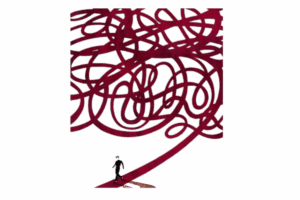

The spiral staircase vividly illustrates the non-linear, often cyclical path through the Stages of Grief.
By Wavebreakmedia | Canva.com
Each step, whether an ascent or a moment of reflection, guides us toward integrating absence and transforming love, in a journey that reflects the essence of grief.
The concept of the stages of grief, particularly the well-known 5-stage framework initially conceived by psychiatrist Elisabeth Kübler-Ross, offers one way to understand the journey of a universal experience: grief. She observed that these stages of grief include denial, anger, bargaining, depression, and acceptance — a framework now widely known. For many, this framework helps answer the question what are the 5 stages of grief, offering an understandable map to navigate loss. Yet it is essential to understand that the journey through grief rarely follows a straight line.
The stages of grief often unfold in a cyclical, non-linear fashion — more like a spiral than a staircase — with emotions reemerging and intertwining over time. This spiral is not a flaw in the process nor a sign of weakness; it is the natural way in which heart and mind attempt to adjust to absence. This understanding of the stages of grief highlights that many times, we find ourselves in a constant ebb and flow between acceptance and pain, hope and longing
Throughout this article, we will explore why grief behaves in this way, connecting the metaphor of the spiral with recent discoveries in neuroscience — particularly the research of Mary-Frances O’Connor — to better understand how the brain learns to live with absence. The aim is to offer a more realistic and compassionate vision, one that embraces both those who endure the loss and those who walk alongside someone in this passage.
Kübler-Ross’s Stages: A Guide, Not a Rigid Script
The 5 stages of grief, described by Elisabeth Kübler-Ross, are not an instruction manual to be followed step by step, but rather lighthouses that, for brief moments, illuminate the darkness of absence.
Denial protects us like a blanket on a cold night, cushioning the first impact and softening the shock of loss. Anger binds us to the injustice of rupture, keeping us alive before the abyss. Bargaining is the whisper of the mind, still trying—though in vain—to regain the control that slipped through our fingers. Depression places us face-to-face with the void that remains, like an echo that insists on answering our call. And acceptance — far from being a happy ending—is the moment when we learn to breathe alongside the pain, recognizing that life goes on, even though it has been forever changed (1, 2, 3). These distinct stages of grief provide a framework, but their progression is unique for everyone.
For those who ask what are the 5 stages of grief, the answer lies in this set of emotional responses that follow no fixed order and may appear unexpectedly. And what almost no one says—but what is essential to understand—is that these stages of grief are not rungs on a ladder. There is no beginning, middle, and end we can neatly mark on a calendar. In truth, grief moves like a spiral. On some days, we seem steady, almost whole. On others, longing, confusion, anger, or emptiness return once more, like waves that find their way back to shore even after an apparent retreat. Sometimes we feel acceptance in the morning, only to find ourselves back on the ground by nightfall.
And this does not mean failure. It simply means we are alive, responding in a deeply human way to a loss that has touched the very core of who we are. Each stage of grief is a temporary anchor in the storm of absence — not to erase the pain, but to make it, little by little, more bearable. This enduring framework, originally proposed by Elisabeth Kübler-Ross, continues to offer invaluable insight into the human experience of loss.
To explore practical coping strategies and tips, see this guide.
Stages of Grief as a Spiral: The Dynamic Reality of Loss
We have already begun to reveal that the stages of grief do not rise like a clear staircase, but dissolve into the shape of a spiral — one that carries us forward and also returns us to places we thought we had left behind. This image is not merely symbolic, but profoundly real for those who grieve.
There are days when the heart seems to find shelter, and the pain yields enough space for a breath. On others, a memory so simple—a voice echoing in the mind, a distant fragrance, a date circled on the calendar—is enough to cast us back into the very moment of loss. This alternation, this weaving in and out of emotions, is the true dance of the stages of grief. They do not end in themselves but repeat and intertwine, serving as delicate mechanisms through which the mind and heart attempt to adjust to the void.
For those who find themselves wondering what are the 5 stages of grief, the answer lies in this spiraled path: each stage offers, for brief instants, a different emotional anchor. In denial, we find a fleeting sigh of relief; in anger, the energy to keep breathing; in bargaining, a fragile sense of control. Depression confronts us with the depth of the emptiness, and acceptance teaches us how to continue, even if marked by scars. None of these stages exist to erase pain; their only mission is to make it—step by step—more bearable.
And this spiral readies us for something deeper still: our mind constantly seeks to adapt and learn to cope with absence.
The Grieving Brain: Neuroscience’s Revelations (Mary-Frances O’Connor’s Perspective)
Grief is not only a pain felt in the heart—it is also a silent earthquake that ripples through the most intimate networks of our brain. Neuroscientist Mary-Frances O’Connor, teacher at the University of Arizona and author of The Grieving Brain (4), has devoted her career to deciphering how the mind responds when someone we love no longer inhabits the physical space they once held in our lives.
According to her research, we do not suffer solely because of absence; we suffer because the brain—shaped by years of shared moments—still expects that presence.
It is as if we live with an inner map, meticulously drawn, that suddenly no longer matches the territory before us. The streets still exist in our memory, but they lead to places where no one remains. And until this map is redrawn, we dwell between two worlds: the one of reality, and the one of expectations that stubbornly refuse to fade (4).
Mapping Presence: How the Brain Anticipates (and Feels the Absence)
Our brain operates through inner maps—mental models that predict the world around us. These maps are not limited to streets and places; they guard, like invisible treasures, the presences we love. Over the years, they record the cadence of footsteps in the hallway, the timbre of a voice we recognize even from afar, the brief touch on the shoulder, the fragrance that heralds an arrival. Every sensory detail becomes a fixed coordinate in our emotional geography, reinforcing circuits that tell us when to expect a message or how to anticipate a familiar gesture. This neurological underpinning helps explain the complex nature of the stages of grief.
When loss occurs, the body may recognize the absence, but the brain—still guided by these maps—keeps its circuits of expectation alive, as if awaiting at any moment the reunion (4). It is as though the map still points to a place that no longer exists, a road that no longer leads where it once did. This disconnection between the real territory and the internal one is the very heart of the learning grief demands: learning absence.
O’Connor calls this the learning of absence — the painful task of the brain updating its emotional geography to a territory where physical presence dissolves, yet emotional presence remains alive. It is a learning that does not sever the bond but transforms it, keeping alight in memory the lighthouse that once navigated by touch and now is guided by remembrance (4).
Reconfiguring Connections: Grief as the Brain’s Learning
The connections of affection and expectation do not unravel in the instant someone departs. They remain alive, like pathways that suddenly lead nowhere. This continuity without arrival creates an internal noise—a kind of silent discomfort, made of emptiness and estrangement—that does not fade quickly, reflecting how the neurological underpinning influences the complex nature of the stages of grief.
At the deepest level, grief is also a process of reconfiguring neural networks. The bonds once formed to anticipate gestures, voices, schedules, and presences keep firing as if the connection were still possible in the physical world. It is as though the brain, accustomed to a familiar emotional territory, had to redraw its map—erasing roads that once led to a meeting and tracing others that lead only to remembrance. This reconfiguration is not simple; it demands repetition, time, and new emotional associations so that the circuits of expectation can adapt to absence.
This is why the stages of grief—denial, anger, bargaining, depression, and acceptance—can appear in a confusing, repetitive, and out-of-order manner. It is not emotional incoherence, but the reflection of a brain trying, countless times, to update its inner map to a world where that specific presence no longer exists (4). This work is slow, unfolding through the repetition of emotional experiences, through the confrontation between memory and reality, until the inner pathways settle into a new design.
Acceptance is not resignation. It is the capacity for the person to reallocate the bond, finding ways to keep the emotional connection alive in memory and heart.
Grief as the Continuation of Love
For O’Connor, grief does not end love — it transforms it. Physical togetherness dissolves to make room for symbolic presence; touch and conversation yield to remembrance and the intimacy kept within the heart. When physical presence ceases to exist, the bond does not vanish: it withdraws inward, finding new ways to endure (4). This perspective offers a profound understanding beyond just the typical view of the stages of grief.
This love, once woven into daily gestures, comes to dwell in memory, meaning, and symbol.
The pain that lingers is, paradoxically, proof of the deep bond that once blossomed and of our human capacity to connect with another soul in a genuine way. Over time, we learn to transform absence into memory, physical presence into meaning, and lived love into preserved love.
To internalize the bond is a profoundly human act. It is the brain, after countless attempts and adjustments, finding a safe place to safeguard affection—preserving it as an inseparable part of who we are. To live, then, is to go on loving, even if in a way reshaped by absence (4). In this sense, grief is not the end, but the metamorphosis of a bond that discovers new ways to become eternal.
Practical Implications: Navigating Your Own Journey Through Grief
There is no universal script for stages of grief. No fixed steps, no timetable to obey. Each story of loss is uncharted territory, and each heart learns to walk it in its own way. This non-linear experience is fundamental when considering the stages of grief.
Allow yourself to feel. To cultivate self-compassion is to recognize that, on the days when absence feels unbearable, your brain is still reorganizing its emotional maps, its networks of expectation and memory. This is silent, profound work that consumes both energy and time. Do not pressure yourself to “move forward” quickly; haste can be a way of avoiding what truly needs to be faced.
Patience is the companion that softens this passage. Just like a physical wound, grief demands a period of inner healing—and even when the pain subsides, the scar remains as part of who we are.
Also, allow yourself to seek support. Networks of care, therapy, and sharing groups offer more than comfort—they offer witnesses to your pain, people who remind you that you are not alone on this path. Listening to other stories will not erase your own, but it can illuminate it with new ways to give meaning to the bond.
Grief is not about “getting over.” It is about learning to live with. Absence may become less sharp, but the love that gave rise to the pain remains—reinvented, internalized, transformed into symbolic presence. And perhaps this is what makes us profoundly human: the capacity to go on loving, even in the silence of absence.
Conclusion
Grief is as vast as life itself: it cannot be confined, nor hurried. It is made of comings and goings, of falls and breaths, of waves that return even after long stretches of calm. Understanding the stages of grief through this lens reveals why the spiral is its most faithful metaphor—there is no straight line, no final arrival.
Neuroscience, in the words of Mary-Frances O’Connor, helps us understand that this dynamic is neither flaw nor weakness, but a complex process in which the brain relearns how to live without physical presence while discovering new ways to preserve the bond. The journey through the stages of grief is, in this way, a silent education: to reorganize emotional maps, to transform absence into memory, and lived love into love kept (4).
Grief is like a river that suddenly changes course. At first, we stand at its bank, confused, trying to understand where the water has gone. Slowly, we realize that the river has not vanished—it has simply found another bed, hidden from our eyes, yet still running deep beneath the earth. Learning to live with absence is following the sound of that invisible water, recognizing that love has not been lost; it has only begun to flow in a way no longer seen, but still nourishing us.
And though pain is inevitable, within it lies a seed of continuity. For to love someone is to accept that a part of that love will live forever inside us, even if transformed. Navigating the stages of grief is not about erasing — it is about learning to carry. It is the river that changes course, flowing underground, still nourishing, still present. It is the proof that, despite all, we are capable of continuing to love.
Disclaimer
The information presented in this article is for educational, informational, and personal development purposes only and does not constitute medical, psychological, or professional advice. Please consult a qualified healthcare professional, psychologist, or other specialist for any health concerns, medical conditions, or mental well-being issues. Self-help and general wellness techniques described herein do not replace the guidance of a therapist, psychologist, physician, or other qualified healthcare professional.
The focus of these articles is your human journey, aiming at your personal growth and the improvement of your life. When technical methods from areas of personal improvement are mentioned, they are presented for informational purposes only, to broaden your knowledge and encourage further exploration if desired. Scientific references, when included, serve to illustrate that the topics discussed have a basis in research and foundational studies.
References
1. “The five stages of grief.” (2025, December 24). In Wikipedia. https://en.wikipedia.org/wiki/Five_stages_of_grief
2. Kessler, D. (2019). Finding meaning: The sixth stage of grief. Scribner.
3. Kübler-Ross, E., & Kessler, D. (2005). On grief and grieving: Finding the meaning of grief through the five stages of loss. Scribner.
4. O’Connor, M. F. (2022). The grieving brain: The surprising science of how we learn from love and loss. HarperOne.
About The Author