
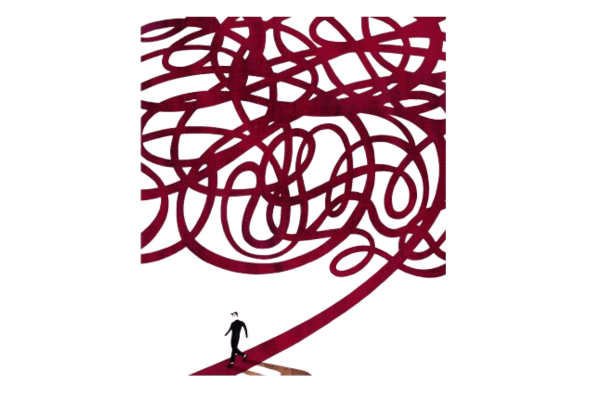
This striking image illustrates the complexity of Prolonged Grief Disorder, where pain intertwines, yet also reveals a possible path out of the tangle.
Canva.com
It represents the journey of those trapped in persistent grief, showing that even within the deepest entanglements, a way exists for transformation and the integration of absence.
There are forms of grief that ebb like the tide, allowing intervals of breath, and forms of grief that persist like an underground river, invisible at the surface yet ceaseless within.
In this second experience, the spiral of mourning loses its motion and life hangs in suspension. What takes hold is prolonged and complicated grief, in which the pain of loss joins the weight of guilt.
When the bereaved suffer, they feel torn apart; when a brief relief appears, they fear they are betraying the memory of the one who left. This constant tension prevents the wound from healing and drains the strength needed to reorganize life.
Science has a name for this phenomenon. Official documents such as the DSM-5-TR (1) and the ICD-11 (2) classify it as Prolonged Grief Disorder, a condition in which pain crystallizes and begins to compromise daily functioning. Neuroscience complements this definition by showing that the brain, as described by Mary-Frances O’Connor, learns familiar presences and is slow to update its inner maps in the face of absence (3). While the mind continues to expect expecting the missing presence, guilt stands guard at the threshold, prolonging suffering even more.
This article seeks to unite science and sensibility, offering a space where pain finds a name, understanding, and pathways of care.
In the sections ahead, it presents the criteria that distinguish healthy grief from Complicated Grief, examines how guilt becomes a central factor in the chronicity of mourning, and outlines possible avenues of care through grief counseling, specialized therapy, support networks, and practices of self-care.
The aim is to offer language to name the pain, scientific grounding to understand it, and practical resources so that absence may be transformed into symbolic presence, allowing the river to flow again, even if in a new bed. Understanding Prolonged Grief Disorder is crucial for effective intervention.
What Is Prolonged and Complicated Grief (PGD)

Canva.com
In some cases, however, this process stops moving forward. The pain holds the same intensity as before, the days remain suspended, and the wound finds no healing.
Science designates this state as Prolonged or Complicated Grief, recognized internationally as Prolonged Grief Disorder (PGD) or Complicated Grief. This condition is formally acknowledged in leading clinical manuals, such as the DSM-5-TR of the American Psychiatric Association (1) and the ICD-11 of the World Health Organization (2). The inclusion of Prolonged Grief Disorder in these classifications underscores its medical recognition.
To distinguish healthy grief from grief that lacks transformative progress, science sets out clear criteria. Prolonged Grief Disorder is characterized by a condition in which pain persists beyond what is culturally expected.
In adults, the diagnosis is generally considered when suffering exceeds a duration of twelve months, and in children and adolescents when it extends beyond six months. During this time, the impact compromises daily life, interfering with work, social relationships, and self-care (1, 2).
It is not merely a matter of suffering for longer, but of experiencing a condition in which adaptation is interrupted and suffering becomes disabling. Such a disabling state is characteristic of Prolonged Grief Disorder.
This distinction also becomes clear when we consider the stages of grief and loss. In healthy grief, those stages—even if not linear—help reorganize life after the loss. In prolonged grief, those phases fail to fulfill their adaptive function and remain suspended, as if the wound could never close. This persistent suspension is a key indicator of PGD.
The contrast between healthy grief and Complicated Grief lies, therefore, in the capacity for transformation. In the first, even with setbacks, there is room for breath, for resuming activities, and for building new meanings. In the second, mind and heart remain caught in a circuit of expectation, unable to reorganize in the face of absence. The brain keeps activating the same pathways that once anticipated gestures, voices, and presences, as if the loss had not been consolidated in the realm of reality (3).
Recognizing this picture is essential. Prolonged Grief Disorder should not be understood as a sign of personal weakness but as a condition validated by science that requires attentive, specialized care. To name the experience helps reduce the weight of individual guilt, brings clarity to those who suffer, and opens space for appropriate care. Identifying prolonged grief is the first step for suffering to find channels of transformation and for life—though marked by absence—to recover its movement. Early detection of PGD is vital for timely intervention.
Symptoms and Diagnostic Criteria
Grief is always marked by pain. However, in its healthy course, that pain finds room to breathe, alternating in intensity until it gradually becomes more bearable. In prolonged and complicated grief, however, the suffering does not subside. Instead, it persists intensely, permeates daily life, and blocks adaptation, as if time had stopped at the moment of loss. This distinguishes it significantly from healthy grief, making it a case of potential Prolonged Grief Disorder.
Clinical manuals offer parameters for identifying when grief takes the form of a disorder. The DSM-5-TR delineates Prolonged Grief Disorder as a state where intense suffering endures for over twelve months in adults, or exceeds six months in children and adolescents, leading to notable impairment in daily functioning (1). The ICD-11 adopts a similar definition, identifying grief that deviates from the socially expected timeline, remaining characterized by intense, disorganizing symptoms (2).
Among the signs most frequently reported in clinical research are the following (4):
- Persistent, intense longing accompanied by deep emotional pain;
- An inordinate focus on the deceased, where intrusive memories frequently pervade daily existence;
- Persistent difficulty in accepting the reality of the death, or its outright denial, even after a significant period has passed;
- Profound sensations of emptiness, isolation, and a diminished sense of self-worth;
- Feelings of indignation, resentment, or culpability specifically tied to the experience of loss;
- Deliberate avoidance of locations, individuals, or circumstances reminiscent of the person who died;
- A marked incapacity to re-engage with normal activities, professional endeavors, or interpersonal connections;
- A pervasive perception that life lacks purpose or a guiding trajectory.
Although they share symptoms such as profound sadness, insomnia, or loss of energy, PGD is distinguished by a sustained preoccupation with absence and an intense yearning for reunion with the deceased (4).
This precise focus on the severed bond explains the designation ‘complicated’: the loss is not integrated into life’s narrative but persists as an unhealed wound. Understanding these distinctions is key to correctly diagnosing Prolonged Grief Disorder.
Recognizing these signs does not mean pathologizing every form of suffering. It offers clarity to identify when grief has ceased to be a natural process of adaptation and has become an obstacle to life itself. This recognition is the first step for persistent pain to find avenues of care and transformation.
Risk Factors for Prolonged Grief
Not every grief becomes a disorder. For most people, even amid deep sorrow, time allows some reorganization of life, the reshaping of meanings, and the quiet return of breath. For others, the process stalls and absence remains open like a wound. In that landscape, risk factors play a decisive role, raising the likelihood that grief will become prolonged. Understanding these distinctions is key to correctly diagnosing Prolonged Grief Disorder.
Research highlights several well-studied contributors: traumatic or unexpected losses, limited social support, prior psychiatric vulnerability, and relationships marked by intense dependence on the deceased (4, 5). These conditions weaken internal and external resources, making adaptation more difficult.
Within this field, guilt deserves special attention. Its impact can be likened to a double-edged sword, where two distinct pains operate simultaneously. On one edge lies the inevitable pain of the emotional bond that has been severed. On the other edge lies the corrosive pain of guilt. Together they create an invisible prison in which the bereaved oscillate between suffering too much and feeling guilty for suffering too little.
Guilt takes many forms. There is the guilt of “feeling good”, as if a brief instant of joy betrayed the memory of the deceased. There is the guilt of “moving forward”, as if resuming life meant abandonment. There is the silent guilt for words not spoken, gestures not made, or simply for having survived. Each version tightens the knot that keeps grief from transforming.
Cultural and spiritual lenses intensify or soften this tension. In contexts that interpret death as annihilation, guilt tends to grow heavier, because any attempt to keep living may be perceived as a total rupture with the one who has died. In traditions that understand death as continuity—whether through memory, spirituality, or transcendence—guilt often finds different, sometimes gentler paths, since the symbolic presence of the deceased remains legitimate in daily life.
Seen in this light, guilt is not merely a private feeling but also a reflection of the cultural and religious frameworks that shape our relationship with death. Precisely for that reason, guilt is a critical yet underestimated factor in the chronification of grief. When it goes unrecognized and unheld, it keeps the bereaved trapped in a cycle that sustains and perpetuates Prolonged Grief Disorder (4).
Understanding guilt as a central clinical risk factor does not mean blaming those who suffer. It means opening therapeutic avenues so that guilt can be reframed, the bond preserved as symbolic presence, and life allowed to move again without erasing love.
Other Contributing Factors
Although guilt is one of the most powerful forces in the chronification of grief, it does not act alone. Prolonged Grief Disorder usually arises from a weave of conditions in which personal, relational, and social elements interlace, creating fertile ground for pain to persist.
The circumstances of death are among the first influences. When the loss is sudden, violent, or traumatic, the mind has no time to prepare. Absence does not settle gradually; it erupts as rupture, leaving images and memories that make acceptance harder.
The person’s psychological history also carries weight. Prior vulnerability to depression, anxiety, or post-traumatic stress increases the risk of developing prolonged grief (4, 5). In such cases, grief does not arrive on neutral soil; it finds a terrain already worn, where the resources for coping are more fragile.
Another decisive element is the level of social support. Grief needs witnesses; it needs eyes that validate pain and offer company along the path of adaptation. When the bereaved feel isolated, without a network of support, absence grows heavier and more solitary. Lack of holding heightens the risk that suffering will become persistent and chronic.
Finally, the quality of the bond with the deceased can either ease or intensify pain. Relationships marked by extreme dependence or by unresolved conflicts complicate the integration of loss. Longing, in such cases, mixes with ambivalent feelings of guilt, anger, or emotional debt, which prolong suffering. All these elements can contribute to the manifestation of PGD.
These factors do not operate in isolation; together they form the backdrop on which prolonged grief can take hold. Recognizing them does not predict destiny; it widens understanding of the possible paths of grief. Identified early, they become points of intervention, allowing more targeted care and opening space for pain to find channels of transformation.
Paths of Help and Healing

Canva.com
Breaking through the emotional barriers of prolonged grief requires effort and support, paving the way for new perspectives and the hope of a clearer and more serene horizon.
If risk factors reveal how grief can become prolonged, the paths of help show that one need not remain forever in the darkness of loss. Recognizing that Prolonged Grief Disorder is not personal weakness but a condition validated by science opens the door to seek forms of care that ease pain and restore movement to life. Effective management of PGD is within reach through specialized care.
Among these resources, grief counseling is one of the most effective. By offering a safe space for listening and holding, it allows feelings such as guilt to be recognized and worked through. More than conversation, it is a structured clinical approach with targeted techniques that help the bereaved reorganize memories, reframe absence, and transform the bond into symbolic presence. A growing body of research shows that grief counseling is particularly effective in Prolonged Grief Disorder, precisely because it interrupts the cycle of persistent suffering through focused interventions (6).
Support groups also play a vital role. Sharing the experience of loss with others who understand the same pain creates belonging and validation. This collective encounter breaks isolation—one of the chief factors that intensify the risk of chronification—and reminds the bereaved that, although their pain is unique, they do not walk alone.
Practices of self-care complement clinical treatment and strengthen day-to-day resilience. Expressive writing helps organize scattered emotions; mindfulness offers anchors in the present; bodily or artistic activities give the body and mind new channels of expression. In religious or spiritual traditions, rituals and prayer sustain continuity of the bond, affirming that love does not vanish; it transforms.
Within this horizon, the notion of Good Grief takes shape: a healthy mourning that, though painful, finds pauses and gradually becomes integrated memory rather than permanent rupture.
Set against Prolonged Grief Disorder, Good Grief clarifies the essential contrast between a grief that allows movement and one that remains crystallized in absence.
Self-care—aligned with grief counseling and communal support—can help build this bridge, so that absence is woven into life as symbolic presence rather than a wound that never closes.
These paths do not erase pain, yet they make it less paralyzing. To move through grief does not mean forgetting the one who died, but learning to live with absence in an integrated way. Each gesture of care—whether in the therapeutic space, in collective sharing, or in the routines of self-care—marks a step toward a life still nourished by love, even in its silent and symbolic form. These interventions are crucial for healing from Prolonged Grief Disorder.
Conclusion
Prolonged and Complicated Grief is more than pain that lingers; it is a condition in which absence crystallizes and prevents life from advancing. Recognizing it as a clinical phenomenon rather than a personal failure is the first step toward breaking the cycle of silence and guilt that so often imprisons those who suffer. Addressing Prolonged Grief Disorder requires empathy and scientific understanding.
Among the risk factors, guilt stands out as one of the most intense and persistent. Its influence resembles a double-edged sword: inflicting pain from the loss itself, and re-inflicting it through the experience of surviving, smiling, or simply living on.
This tension between longing and guilt explains why so many remain held in a state of continuous suffering. Understanding that dynamic is essential to turn guilt into a bridge, not a barrier, so that memory becomes symbolic presence rather than perpetual wound. Science offers paths: grief counseling, therapies designed for Prolonged Grief Disorder, support groups, and practices of self-care. These strategies do not erase pain; they organize it and return movement to what seemed paralyzed.
Grief is not a matter of erasing but of integrating. Absence does not cease to exist, yet it can be transformed into living memory, into preserved love. Like a river that changes its course and runs underground, love too finds new ways to flow—unseen by the eyes, yet still able to nourish those who remain.
This article sought to bring together the firmness of science and the delicacy of a poetic language to show that, even in prolonged grief, there are possibilities for care and transformation. In the end, absence does not extinguish love; it invites it to reinvent itself in silence—resilient and enduring.
Disclaimer
The information presented in this article is for educational, informational, and personal development purposes only and does not constitute medical, psychological, or professional advice. Please consult a qualified healthcare professional, psychologist, or other specialist for any health concerns, medical conditions, or mental well-being issues. Self-help and general wellness techniques described herein do not replace the guidance of a therapist, psychologist, physician, or other qualified healthcare professional.
The focus of these articles is your human journey, aiming at your personal growth and the improvement of your life. When technical methods from areas of personal improvement are mentioned, they are presented for informational purposes only, to broaden your knowledge and encourage further exploration if desired. Scientific references, when included, serve to illustrate that the topics discussed have a basis in research and foundational studies.
References
- American Psychiatric Association. (2022). Diagnostic and Statistical Manual of Mental Disorders (5th ed., text rev.). DOI: 10.1176/appi.books.9780890425787
Link: https://psychiatryonline.org/doi/book/10.1176/appi.books.9780890425787 - World Health Organization. (2019). International Classification of Diseases (11th revision). DOI: N/A
Link: https://icd.who.int/browse11/l-m/en - O’Connor, M. F. (2022). The Grieving Brain: The Surprising Science of How We Learn from Love and Loss. HarperOne. DOI: N/A Link: https://maryfrancesoconnor.org/books/the-grieving-brain/
- Prigerson, H. G., Horowitz, M. J., Jacobs, S. C., Parkes, C. M., Aslan, M., Goodkin, K., … Maciejewski, P. K. (2009). Prolonged grief disorder: Psychometric validation of criteria proposed for DSM-V and ICD-11. PLoS Medicine, 6(8), e1000121. DOI: 10.1371/journal.pmed.1000121
Link: https://journals.plos.org/plosmedicine/article/file?id=10.1371/journal.pmed.1000121&type=printable - Buur, C., Hougaard, E., & O’Connor, M. (2024). Risk factors for prolonged grief symptoms: A systematic review and meta-analysis. Journal of Affective Disorders, 350, 484-492. DOI: 10.1016/j.jad.2023.12.072 Link: https://pubmed.ncbi.nlm.nih.gov/38181586/
- Komischke-Konnerup, K. B., Rosner, R., & Boelen, P. A. (2024). Grief-focused cognitive behavioral therapies for prolonged grief symptoms: A systematic review and meta-analysis. Journal of Consulting and Clinical Psychology, 92(4), 236-248. DOI: 10.1037/ccp0000884 Link: https://pubmed.ncbi.nlm.nih.gov/38573714/
About The Author